The rules in one minute
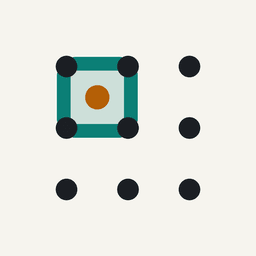
The board is a grid of dots. Players take turns drawing one line between two neighboring dots, across or down. Whoever draws the fourth side of a box claims it, writes their mark inside, and must move again. One line can close two boxes at once, and you still move again. When every box is claimed, the player with more boxes wins. A draw is possible only when the number of boxes is even.
That "must move again" is the whole game. Taking a box is not free: it forces you to draw another line, and late in the game that next line is often one you would rather not draw.
Do not give the third side
Early on, every line is safe as long as it does not become the third side of any box. A box with three sides is a gift: your opponent closes it and plays on. So the opening and middle game are simple to state. Draw lines that leave every box at two sides or fewer, and count how many such safe lines remain.
The trap is that a third side rarely costs one box. By the time the safe lines are gone, the board has sorted itself into chains, and the first third side hands over a whole chain.
Chains and loops
A chain is a run of boxes that each have two sides drawn and are connected through their open sides. Give any box in a chain its third side and your opponent can take the entire chain, one box after another, because each box they close opens the next. A loop is a chain that connects back to itself, with no end boxes. A long chain is any chain of three or more boxes; chains of one or two boxes are short, and they behave differently, as you will see.
Once the safe lines are gone, someone has to open a chain. Whoever is forced to do that first usually loses, unless the other player makes the mistake in the next section.
The double-cross: giving away two boxes to keep control
Suppose your opponent opens a long chain for you. The greedy move is to take every box. But the last box you close forces you to move again, and now you are the one who must open the next chain. You took five boxes and handed over seven.
The better move is to take all the boxes in the chain except the last two. Then, instead of closing them, draw the line at the far end of the chain. That leaves two boxes side by side with their shared side open, a shape players call a domino, and it passes the turn. Your opponent can take both boxes with one line through the middle (the double-cross), but then they must move again, and the only moves left open the next chain for you.
This costs you two boxes per chain. It is worth it whenever the rest of the board is worth more than two boxes to you. On the last chain, take everything. A loop works the same way but costs four: take all but the last four boxes, then draw the line that splits them into two dominoes.
A worked example
Two chains are left: a chain of four and a chain of five. It is your opponent's move, and they open the four.
Greedy: you take all four, then you must open the five. Final count from here, you 4, opponent 5.
Double-cross: you take two boxes, then draw the right end of the chain and stop.
Your opponent closes both boxes with the middle line, then has to open the five. You take all five. Final count from here, you 7, opponent 2. Same chains, same position, five boxes of difference, and the only thing that changed was declining the last two.
Short chains and the hard-hearted handout
When you are the one forced to give something away, give the smallest thing on the board: a single box, or a chain of two. Short chains are the currency of the middle game. Each one you can hand over changes who runs out of safe moves first, which is why experienced players split boxes off into ones and twos while there is still time.
If you must open a chain of two, draw its middle line, not an end. Opening from the end leaves the domino shape, and a sharp opponent will decline it, draw the far end, and hand it back to you. Opening through the middle gives both boxes a third side at once, so they cannot be refused.
The long chain rule
You can plan all this before the chains even exist. Count the dots on the board. The first player wants the number of dots plus the number of long chains to come out even; the second player wants it odd. Loops do not count, and neither do chains of one or two. The rule assumes the player in control keeps using the double-cross, so treat it as a strong rule of thumb rather than a guarantee.
In practice that means: in the middle game, if the count is wrong for you, try to split a long chain into short pieces or join two long chains into one. If it is right for you, keep it that way. For the boards in Dottle:
| Board | Dots | Lines | Boxes | First player wants this many long chains |
|---|---|---|---|---|
| 3x3 | 16 | 24 | 9, no draw possible | even (0 or 2) |
| 4x4 | 25 | 40 | 16, draw possible | odd (1 or 3) |
| 5x5 | 36 | 60 | 25, no draw possible | even |
| 6x6 | 49 | 84 | 36, draw possible | odd |
On the 3x3 board, for example, the second player is happy with exactly one long chain running through the middle, and the first player should try to break it into two or avoid it altogether.
Practicing in Dottle
Dottle is a good place to drill all of this because the AI plays the ideas above. Easy mostly draws random lines and sometimes grabs a free box. Medium always takes free boxes, never gives a third side while a safe line exists, and gives away as little as possible when forced. Hard counts chains, uses the double-cross to keep control, and solves the endgame exactly when few lines remain. The AI starts on Easy and levels up each time you win, so you meet each idea when you are ready for it.
Start on 3x3, where there are only 24 lines and no draws, and play until you can predict which chain opens first. Move up to 4x4 and 5x5 when you want to practice splitting chains, and use 6x6 for long endgames with several loops. Two Players on one device is the fastest way to test a line of play against a friend, and Undo takes back your whole last turn, including any boxes you chained.
More guides from SempaQ.